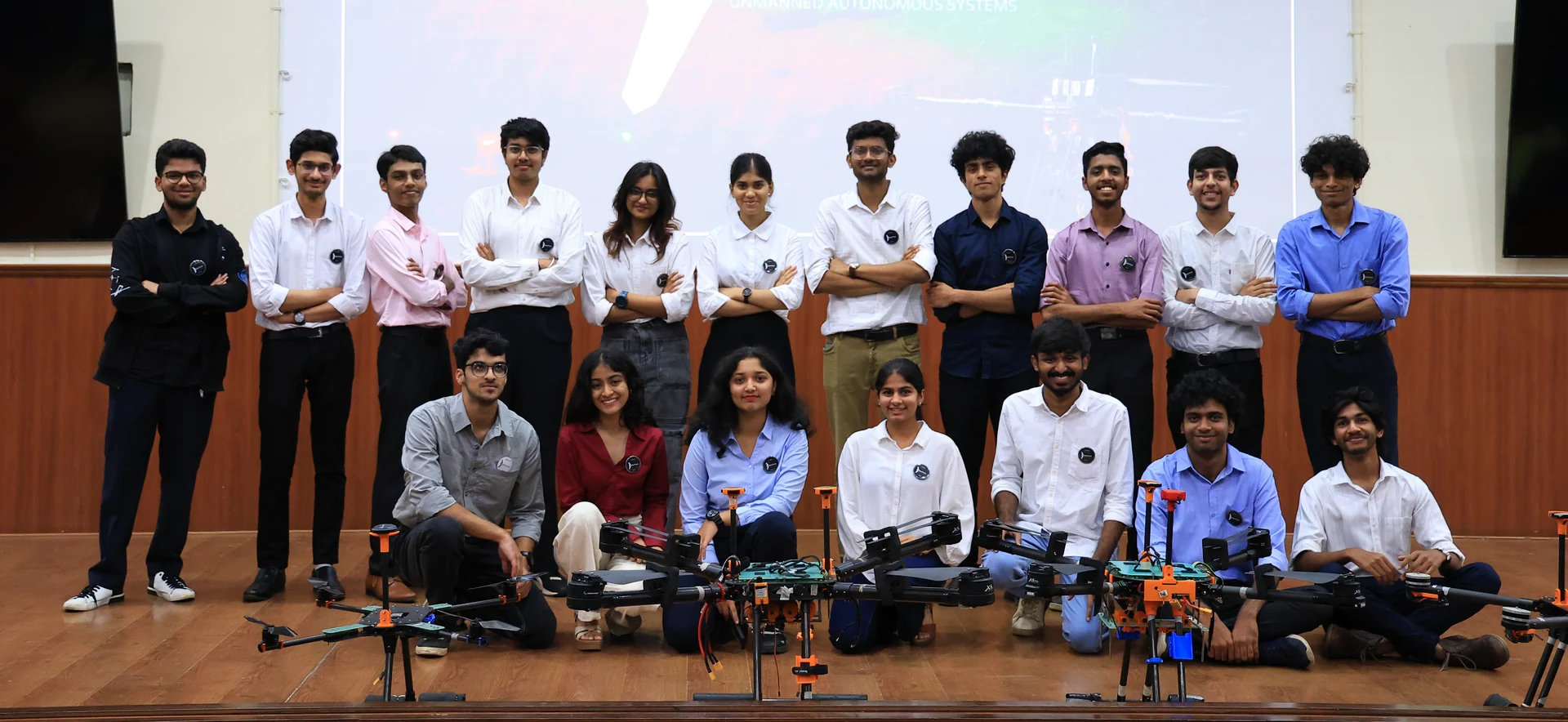
Four subteams, one aircraft.
Every aircraft we fly is the work of all four subteams.
Structures & Propulsion Systems
SPS designs and builds the airframe. It starts here, with the frame, drawn in CAD around everything the other subteams need to carry.
Modal analysis
SPS runs a modal analysis on the frame, keeping its natural frequencies clear of the motors’ speed range so vibration stays out of the electronics. Shown here: a twisting mode, exaggerated.
Stress analysis
Before anything is cut, SPS checks the arms and plates under thrust, landing and crash loads. Hot colours mark where the stress collects.
Mounts and fasteners
SPS designs a mount for every other subteam’s hardware, along with the standoffs and landing legs, and fixes them all to the frame.
Propulsion
Propulsion is SPS’s too: choosing motors and props to match the aircraft’s weight and flight time.
Four motors
SPS lays out the four motors, one at the end of each arm in opposite-turning pairs, and bolts each one down from under its arm.
Ready for the electronics
With the props on, SPS hands over an airframe that can fly.
Avionics, Electronics & Navigation
AEN makes it fly. They integrate the flight controller and ESC stack at the centre of the frame, on vibration isolators, and wire it to every motor.
Tuning
AEN tunes the control loops flight by flight, until the aircraft holds its attitude and settles quickly after a knock.
Navigation
AEN integrates the GNSS receiver at the tail and builds the position-aware navigation on top of it.
Link
AEN runs the link to the ground station. Its antenna waits to one side until ICS has fitted the onboard computer it plugs into.
Sensing
AEN brings in the sensors the flight controller relies on, such as the LiDAR under the nose that measures the height above the ground.
Power
And the power: AEN fits the battery pack under the frame and the wiring that feeds everything on board.
Imagery & Cyber Systems
ICS gives the aircraft its eyes and its brain. They integrate the depth camera at the nose, for depth perception.
Vision camera
For seeing, ICS fits a vision camera under the aircraft, looking straight down at the ground.
Camera calibration
ICS calibrates it: a checkerboard of known size, shown to the camera at many angles, gives its focal length and lens distortion.
Detection
ICS builds the object detection that picks targets out of the camera’s images and locates them on the ground.
Onboard computer
ICS runs all of it in real time on the OBC, the onboard computer.
Link connected
With the onboard computer in, AEN’s link antenna plugs into it, and the aircraft can talk to the ground station.
One aircraft.
Every part fitted by the subteam that owns it. Every aircraft we fly is the work of all of them.
Business Development
Business development: the events, sponsors and partnerships that keep the team travelling, building and flying.
What they work on
- Event management
- Sponsor relations
- Partnerships